
The crosswalk light is taped over, covered in a black trash bag.
It’s a weekday morning in early summer, and bumper-to-bumper traffic snakes down the roads feeding into Milton Village. Despite the lines of cars, it’s nearly desolate. Office workers use the intersection to avoid I-93 by cutting through the crossroads between Milton and Dorchester, over the Neponset River, but they don’t stop.
I watch the traffic pattern for a few minutes, then make a run for it across the street.
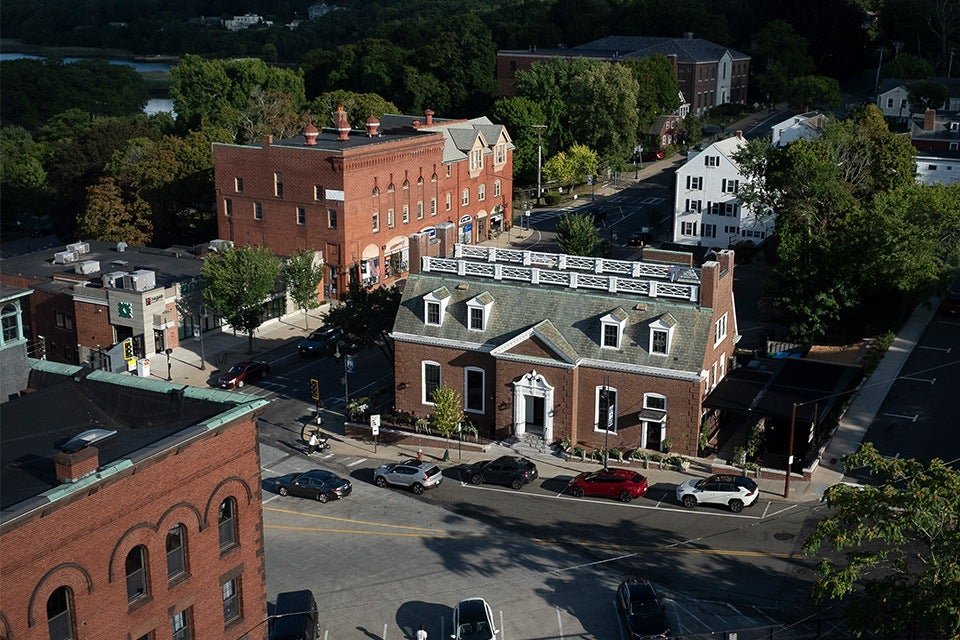
At first glance, Milton Village has all the makings of a bustling downtown: historical factory buildings straddling the river, character-filled architecture, a bike trail, a waterfront walking path, a trolley. But for years it’s been more cut-through than downtown, a place commuters drive through and residents stop only long enough to run an errand—a withdrawal from the ATM, a trip to the hardware store, a manicure. Not much has changed over the past few decades. “It’s very transactional. People try to avoid the area because it’s so crowded with cars,” JD Wild, a developer and Milton resident who owns a handful of buildings in the neighborhood, tells me. “That’s what is broken about the model now. You can’t blame them. There’s no reason to stop.”
But this summer, Wild and a few fellow Miltonians set out to give them a reason.
In late July, Wild, as well as Steel & Rye owner Dan Kerrigan and culinary director Brendan Joy, opened Two Pence Market inside a refurbished circa-1929 bank, smack dab in the center of Milton Village. The neighborhood market sells coffee and lunch, fresh produce, specialty groceries, and Toscanini’s ice cream. But the idea was to make it something Milton Village has long lacked: a place to stop and stay awhile. They picture families getting ice cream and walking across to the river and people on bikes stopping in after a ride—in other words, the kind of foot traffic that gives a suburban downtown a reason to exist. For Wild, Kerrigan, and Joy, Two Pence is also a first test of a considerably bigger idea—whether one successful project can begin to change the way people use the village around it. “There are all these opportunities for engaging people in the area. The infrastructure is all there,” Kerrigan says. “It’s about waking it up and letting people know it’s here.”
The ambition is hardly new. For decades, Milton has studied, planned, and debated ways to bring more life to this little stretch along the Neponset. The bones have been here all along. Turning them into a downtown, though, has proved considerably harder.
Milton Village was once busier. A lot busier.
With its proximity to Boston and prime location on the Neponset River, Milton became a bustling center of industry by the early 19th century. Mills and factories clustered along the river, producing everything from gunpowder and paper to chocolate.
Chocolate would become the village’s signature industry. The circa-1760s chocolate mill on the Neponset was the first in the country. The company that grew out of it became one of the area’s major employers. By the late 1800s, Milton Village had the sort of everyday commercial life its boosters are trying to create again: shops, workers, residents, and trains moving through the neighborhood.
Centuries later, much of the infrastructure remains. The brick-clad Baker Chocolate mill buildings still rise above the Neponset, a bike trail follows the old rail line, and the Mattapan Trolley—albeit underutilized—runs through it all. “Historic structures are what define the character of the Milton Village district,” says Cheryl Tougias, an architect and longtime member of the Milton Planning Board, who has advocated for a revitalization of Milton Village. There have long been conversations about “how to make these things more connected, how to make it feel more like a neighborhood,” she says.
The conversations have been going on for decades. As early as 2000, a town revitalization committee was formed to study some of the same places still under discussion today, including the old Baker Chocolate properties and the Neponset waterfront. The committee contributed to projects being zoned for mixed-use development, including 88 Wharf, which now includes Madre Osteria & Bar, and the former Hendrie’s Ice Cream plant up the road on Eliot Street, now home to housing and businesses near the Central Avenue trolley stop.
The planning continued. Milton’s 2015 Master Plan called for zoning changes that would allow mixed-use redevelopment in Milton Village; more studies followed, and in 2020 the town approved a new mixed-use zoning overlay for the neighborhood. On paper, at least, Milton Village was increasingly ready for something to happen.
Five years later, Milton Village looked much the same. “We passed that zoning in 2020, but we really haven’t seen a lot of change since that time,” Tougias says.
Milton remains technically “dry”: Liquor licenses require special legislative approval, and the town’s first restaurants with full licenses didn’t open until 2009. What exists today is an odd mix of the village’s past and its more utilitarian present. “You have the train, you have the bike path, and a lot of people forget that there is a beautiful wharf right over there with a walking path and a park,” says Ian Grigorio, a lifelong Miltonian and admin of the town-focused Facebook group Everything Milton MA. There’s Milton Village Hardware, which has been in the same spot since 1918, a hair salon, a nail salon, Madre Osteria & Bar—then a few slightly less, ahem, exciting places: a realty office, a drive-through bank, and a massive self-storage facility. “But there’s nothing really drawing people in,” Grigorio says.
Colby Thomason, the owner of Milton Village Hardware, sees a neighborhood that many residents barely use. “It’s a part of Milton where people who have lived in Milton for 20 years don’t even go, or don’t even know it’s a part of Milton,” he says.
Wild came to the same conclusion in 2019, when he purchased nearly 26,000 square feet of Baker Chocolate buildings at One Eliot Street. “I learned that the town of Milton was really underserved by commercial businesses.… For as big of a town and how close to the city it is, people can really get their services by leaving Milton,” he says, namely by crossing the river into Dorchester’s Lower Mills for dinner, sweet treats, shopping, and even groceries. “It opened my eyes to the opportunities in Milton Village and what it could become,” he says.
At One Eliot, Wild turned an outdated gym into the three-story, all-ages fitness center Muscle & Flow, opened an office for his business, the Elevated Companies, and began eyeing the riverside space out back. When the old Bank of America—and before that, the Blue Hill Bank & Trust Company—went up for sale in 2023 directly across the street at Two Eliot, he saw another opportunity. He bought it, imagining the 4,500-square-foot building as a “gateway” to Milton as you arrive from Boston.
What would go inside was less obvious. Wild eventually turned to the Steel & Rye team, whose restaurant sits just up the road by Central Avenue. “We started exploring what would be the best use of that space in that specific location for our community,” Kerrigan says. “How could we serve the community the best way?”
They landed on Two Pence: a neighborhood market built around the very behavior they wanted to see more of in Milton Village—people coming in for coffee or lunch and then sticking around. “The energy was very closed off, like a fortress,” Wild says. Kerrigan adds, “We talked about how to make the building something welcoming that people want to come into.”
They pulled down fencing to make room for two patios and a walk-up ice cream window. The old check-cashing stations became checkout counters. They restored the original chandeliers and turned the bank vault into a wine cellar. Penny tiles and framed bank documents nod to the building’s former life.
On my visit in early summer, a woman in gym clothes wandered over from across the street and cupped her hands against the glass to peer inside at the construction. Kerrigan told me it had been happening a lot. The building was originally designed to keep people out. Now they were trying to see in.
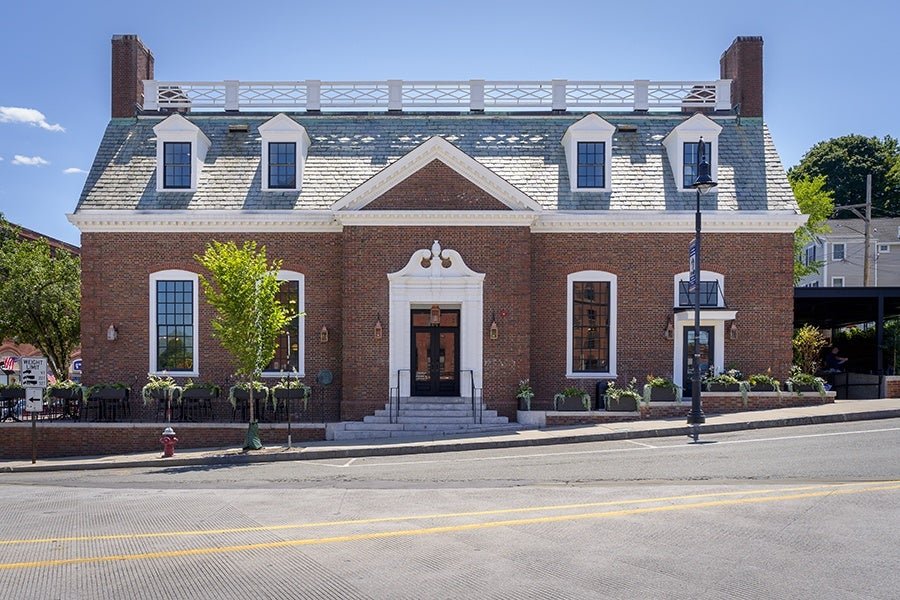
Two Pence Market in Milton Village. / Photo by John Gillooly
On Two Pence’s opening week at the end of July, Milton Village showed a glimpse of what Wild and the team have been talking about. Kids ran around outside with ice cream cones; groups milled around inside, buying vegetables from the bank-cart-turned-produce-stand, grabbing lunch from the hot bar, and then sitting on the flower-box-bedecked patio out front.
One busy market, though, does not make a downtown. The bigger test is whether Two Pence can become the first of the chain reaction Wild and others are betting on.
Wild secured a liquor license for a potential brewery and restaurant on the water behind his Muscle & Flow gym, and he also owns several other buildings in Milton Village, including 50–64 Adams Street. At the same time, he’s working with another group of Milton residents and local organizations to revitalize the Neponset River waterfront, particularly Wharf Park, where the Milton Farmers Market is currently held. They’ve secured funding from the town’s Community Preservation Act and are angling for additional private fundraising to turn the area into a public space with ADA-compliant paths, seating, a performance space, and bike facilities. Construction is slated to begin this fall.
Other property owners have been trying to make things happen, too, including Michael Roberts, a developer who owns two properties in Milton Village. He bought the former Swift Hat Shop—a historical 1790s-era building that sits in disrepair today—in the mid-1990s and the adjacent home a decade later. He’s tried to develop the properties over the years, at one point offering to move the hat shop elsewhere to preserve it and, years later, proposing a cannabis dispensary. Again and again, he says, his plans have gone nowhere amid fights over what should happen to the property. “People decided that the Swift Hat Shop was the most important building in the world,” Roberts says. “We’ve come up with so many different plans, and it always comes down to people voting against it.” Roberts’s most recent plan is to redevelop the buildings into multifamily housing.
Roberts is hardly a neutral observer: He’s a developer who has spent decades trying to do something with property he owns. But his frustration points toward a question that has complicated development in Milton for years: not simply whether the town should change, but what that change should look like.
This year, Milton officials are seeking to designate Milton Village as a historic district, an idea first raised in the town’s 2015 Master Plan. As of presstime, Lawfer said that the committee was planning for three public comment meetings, followed by a town meeting vote this fall.
From the old bank and the Baker Chocolate buildings to the Swift Hat Shop, the historical architecture gives the neighborhood the character developers like Wild hope to capitalize on. Historic-district designations protect that character by giving the town approval over changes to certain properties. Wild worries Milton’s proposed district will make development more complicated. “Adding a local historic district [on top of the existing approval process] would introduce an additional layer of approval—a separate, unilateral body of governance—that would affect the duration, feasibility, and clarity of the process going forward,” he says.
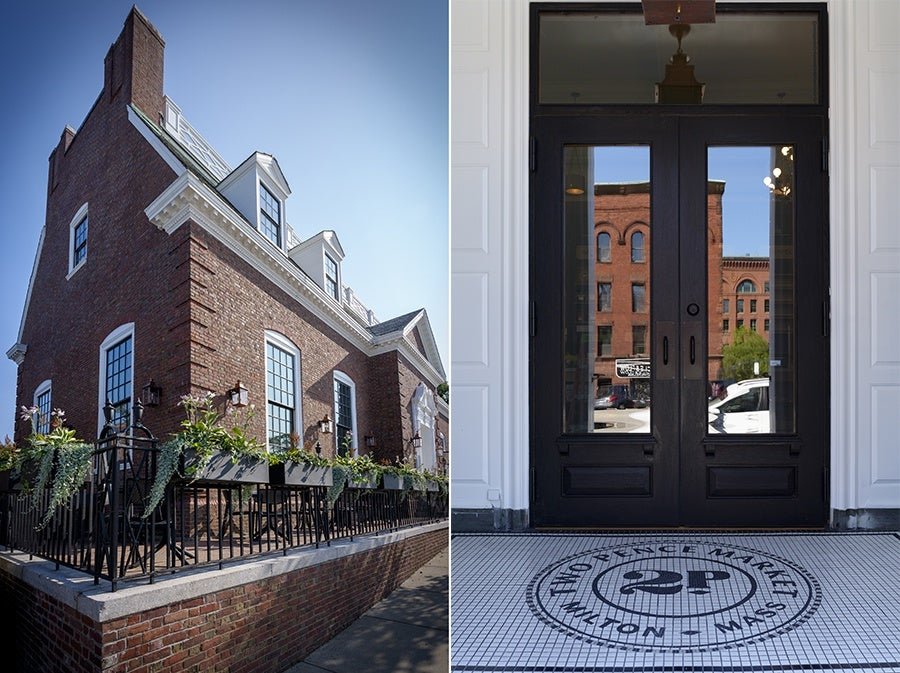
Two Pence Market in Milton Village. / Photo by John Gillooly
But Larry Lawfer, chair of the Historic District Study Committee, says developers have misunderstood how restrictive Milton’s proposed district would really be. He says the proposed bylaw is concerned almost entirely with what can be seen from the street. Developers could remake interiors and renovate exteriors, he says, as long as they preserve the historical character of the façade. Projects like Two Pence are exactly the kind of positive reuse the historic district committee wants to see. “We’re not going to be hard on this,” Lawfer says of the eventual approval process. “We want the town to grow.”
The proposed district would, however, put a significant restriction on development: Historically significant buildings couldn’t simply be torn down to make way for something new. Still, the possibility of larger redevelopment is part of the debate over the neighborhood’s future.
Questions about this kind of development have recently produced much bigger battles in Milton. In 2024, voters rejected a zoning plan intended to bring the town into compliance with the MBTA Communities Act, which requires MBTA communities to zone for multifamily housing. Much of the opposition centered on fears of large housing developments—and with them more residents, traffic, and parking pressure. Milton ultimately adopted a compliant plan in 2025, but those concerns haven’t disappeared. One flash point, for instance, is a new 92-unit residential building now under construction in East Milton Square. On social media, Grigorio likened the project to the Titanic.
Some of the objections are practical, particularly around the additional traffic that larger developments could bring to already-congested areas like Milton Village. Others are plainly aesthetic. “It’s very imposing; it’s not attractive. I’m disappointed that we’ve agreed to such extravagant buildings,” says Ed O’Donnell, a 60-plus-year Milton resident known around town as the “Milton Cowboy” for the cowboy hat he wears on his daily walks. Residents have concerns, Tougias concurs, about “bland architecture” and a “lack of character.”
In other words, no soulless modern structures, please.
That’s not to say that no housing will be built in Milton Village: Lawfer says that the historic committee wouldn’t oppose housing built to replace historically “insignificant” buildings in the neighborhood—like a proposal for a few dozen new condos atop 40 Adams Street, a building that already had a modern façade. “The developer is going to build something better there, and we need more housing,” Lawfer says.
For his part, Wild says his intention is “preserving and restoring these important buildings while adapting them to serve the needs of the community.” Two Pence, with its bank-inspired design, is just one example. What he ultimately does with his other properties remains to be seen.
Roberts, for one, still believes one project can make a difference. “It only takes one good building where somebody puts down their money and says, ‘This is what can happen here,’” he says. “If it’s the right building, it can change the area completely.”
By the end of opening week, Two Pence was busy. Kids carried ice cream onto the patio, and people lingered over lunch. Across the street, though, cars still backed up through the intersection, commuters following the same route they had all summer. The old mill buildings still rose above the river, and Milton Village remained a long way from transformed.
One thing had changed since my first visit: The black trash bag was gone from the crosswalk light. This time, when I crossed the street, I waited for the signal.